Parent Child Relationship
Parent Child Relationship and the Role of Technology
Parent Child Relationship in Today’s Changing Family Environment
How Expectations Shape the Parent Child Relationship
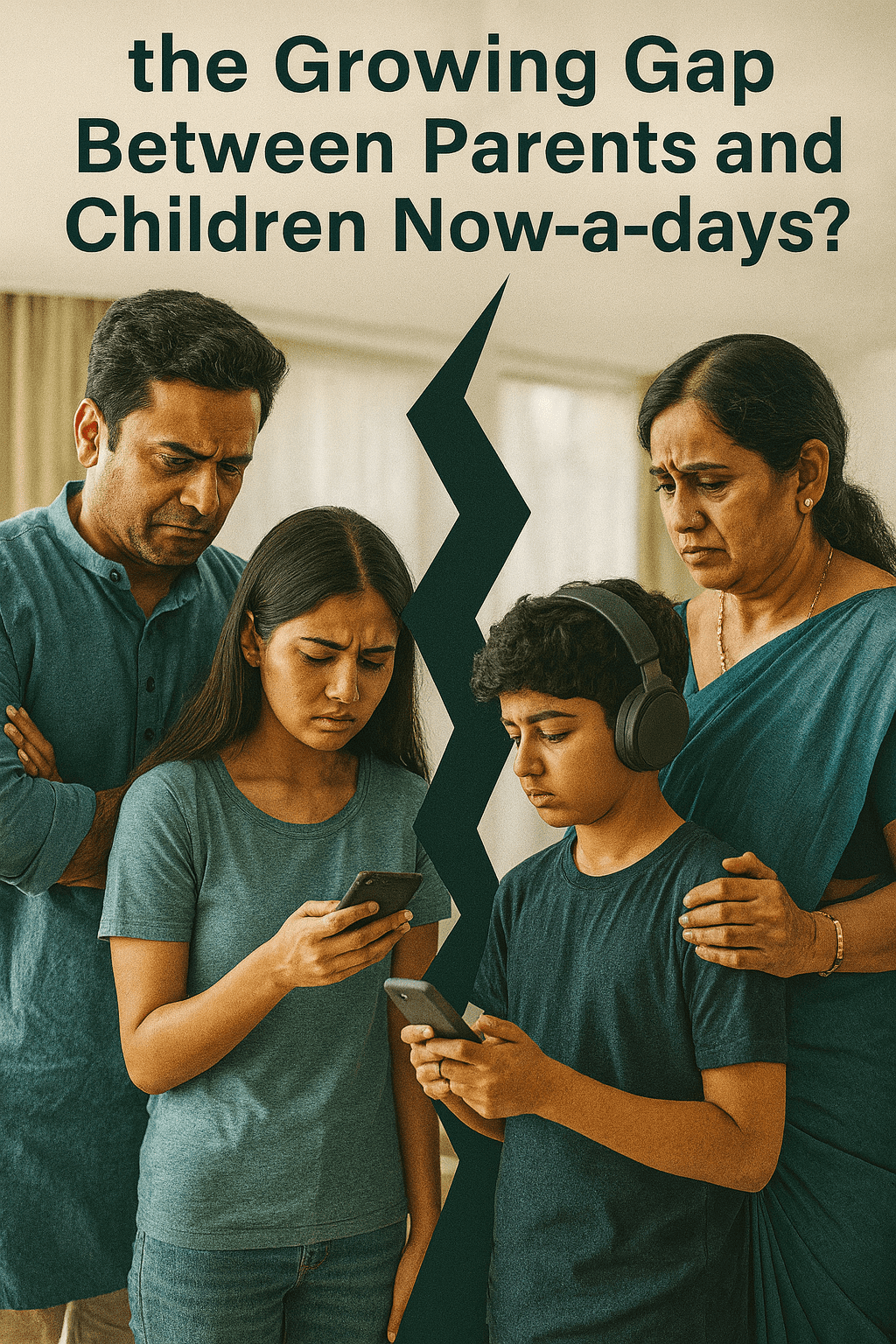
The parent child relationship plays a vital role in shaping a child’s emotional, social, and mental development. In today’s fast-changing world, differences in technology use, expectations, and lifestyle patterns have significantly influenced the parent child relationship, often creating gaps in understanding between parents and children.
The main reasons are clearly detailed below:
1. Technology Gap – The Biggest Cause of the Generation Gap
Children are growing up surrounded by smartphones, YouTube, reels, gaming and AI technologies.
On the hand parents were raised in a time without the internet.
- This gap leads to a separation in:
- The way they express themselves
- Their way of thinking
- Their conduct
As a result misunderstandings happen frequently.
2. Traditional Parenting vs Modern Mindset
- Discipline was earlier described as: “Follow the rules.”
- Today children interpret discipline as: “Explain the reason, behind the rule.”
- Modern youngsters seek openness, logic and clear communication.
- Parents often rely on their experiences when deciding.
- This inconsistency leads to conflicts and annoyance.
3. Study Pressure + High Expectations from Parents
Most parents want their children to:
- Score the highest marks
- Excel in every activity
- Be ahead of others
Nonetheless children today are already exposed to stress from:
- Academics
- Competitions
- Social standards
Disputes frequently arise when abilities fail to meet standards.
4. Emotional Communication Gap
- Parents believe: “Providing everything demonstrates love.”
- Children convey: “We need care, time and someone who listens attentively.”
Each side is accurate according to their perspective. Only their communication styles are different
This emotional gap creates division.
5. Lifestyle Changes & Reduced Family Time
- The number of families has declined
- The count of households is increasing
- Parents are busy with work
- Children spend time in front of screens
- Sharing time results, in bonds and heightened misunderstandings.
Kids desire. Liberty.
Parents seek safety, structure and responsibility.
This continuous exchange creates strain, for both sides.
7. Fast-Changing Society & Influences
Values and environments are changing swiftly than, at any other time.
A child’s way of thinking is influenced by:
- School culture
- Friends
- OTT platforms
- Cartoons
- YouTubers and influencers
Parents struggle to keep up with these changes increasing the gap.
The growing gap between parents and children arises from a mix of technology differing expectations, lifestyle shifts and changes, in communication.
Understanding each other’s perspectives and spending meaningful time together can reduce conflicts and build stronger family bonds.
FAQ
? What constitutes a healthy relationship with your child?
A healthy relationship with your child
A positive parent and child relationship is built on trust, effective communication, mutual emotional support, and mutual respect. A positive parent and child relationship is important in that it enables the child to feel safe, be confident, and be understood.
? What is driving the evolution of the parent-child relationship today?
The parent and child relationship is undergoing shifts because of the utilization of technologies and academic pressures among other lifestyle changes coupled with exposure to social media.
? How can parents optimize their parent and child relationships?
To strengthen the relationship between parents and children, parents can engage quality time, practice judgment-free listening, establish boundaries, and provide reasoning for rules.
❓ Does technology influence the parent-child relationship?
True, too much screen time can lead to less communication, but controlled use of technology can actually improve learning as well as parent-child bonding.
❓ In what ways can schools assist with the parent child relationship?
Schools help strengthen the parent-child relationship in counseling sessions, parent workshops, regular communication, and value education.