Experiential learning in schools helps children understand concepts through hands-on activities, real-life experiences, and practical learning methods.
Children are naturally curious, they love asking “Why does this happen?” or “How does that work?” At Prime World Public School, Saket, Meerut , we believe science is not just about memorizing facts—it is about nurturing this natural curiosity and giving children the opportunity to explore, experiment, and discover.
That’s why we encourage our students to become “little scientists at work” through simple, hands-on experiments. These activities not only make learning exciting but also teach children critical skills such as observation, problem-solving, and teamwork.
Experiential learning in schools encourages students to actively participate in learning through hands-on activities, real-life tasks, and meaningful classroom experiences.
In this blog, let’s explore how our classrooms turn into mini-laboratories where children experiment, learn, and grow.
Why Simple Experiments Matter in Primary Education
For young learners, concepts like gravity, air pressure, or magnetism may sound too big. But when explained through simple experiments, these ideas become magical discoveries.
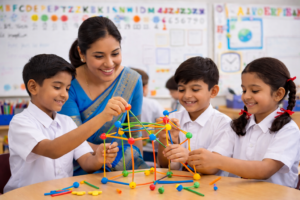
- Hands-On Learning: Children remember better when they see and do, instead of just listening.
- Critical Thinking: Experiments encourage kids to ask questions, predict outcomes, and analyze results.
- Confidence Building: Completing an experiment gives a sense of achievement.
- Teamwork: Most experiments are group activities, teaching cooperation.
- Fun with Learning: Science turns from a “tough subject” into a joyful adventure.
Examples of Our Classroom Experiments
Here are some favorite activities our students enjoy as “little scientists”:
1. Volcano Eruption with Baking Soda & Vinegar
- Setup: A cone made of clay or paper with baking soda inside. Vinegar mixed with a bit of red food color is poured in.
- What Happens: The mixture fizzes and erupts like lava.
- Learning: Children understand chemical reactions (acid + base) in a fun, visual way.
- Excitement Factor: The oohs and aahs when the “lava” flows are unforgettable!
2. The Magic of Floating and Sinking
- Setup: A tub of water with objects like a stone, leaf, coin, sponge, and plastic toy.
- What Happens: Some objects float, others sink.
- Learning: Kids discover the concept of density and buoyancy.
- Extension: We ask children to predict first—“Will this float or sink?”—to sharpen observation.
3. Rainbow in a Glass
- Setup: Different sugar-water solutions (varying sugar amounts) are colored with food coloring and carefully poured into a glass.
- What Happens: The liquids layer into a rainbow.
- Learning: Introduction to density and solutions.
- Wow Moment: Children love watching “magic” happen as the colors don’t mix immediately.
4. Balloon Rocket
- Setup: A straw is threaded on a string tied across the classroom. A balloon is taped to the straw. When the balloon is released, it zooms across.
- What Happens: The balloon propels forward like a rocket.
- Learning: Newton’s Third Law of Motion—every action has an equal and opposite reaction.
- Fun Part: Children cheer as their balloon rockets race each other!
5. Seed Germination in Cotton
- Setup: A few seeds (beans or grams) are placed in wet cotton inside a transparent cup.
- What Happens: Seeds sprout roots and shoots in a few days.
- Learning: Kids witness the life cycle of a plant.
- Connection: They care for the seeds daily, learning responsibility and patience.
6. Magnet Magic
- Setup: Magnets and objects like paper clips, coins, erasers, and buttons.
- What Happens: Kids test what attracts and what doesn’t.
- Learning: Introduction to magnetism.
- Bonus: “Magnetic fishing game” where they pick paper fish with hidden clips.
According to educational research, experiential learning improves student engagement and understanding.
Skills Children Develop
Through these experiments, children learn much more than science concepts. They develop:
- Observation Skills: Looking closely at what changes.
- Prediction & Hypothesis: Guessing outcomes before trying.
- Patience: Waiting for results (like with plants).
- Recording & Sharing: Drawing or writing about their experiments.
- Collaboration: Working in teams.
One Grade 2 student, after the balloon rocket experiment, said:
“Now I know why rockets go up in the sky. It’s like my balloon but stronger!”
Moments like these show that real understanding is happening.
Role of Teachers
Our teachers act as guides, not just instructors. Instead of giving all answers, they encourage children to explore:
- Asking guiding questions: “What do you think will happen if we add more water?”
- Encouraging multiple answers: There’s no single “right way” to think.
- Linking experiments to everyday life: “Why do some fruits float when we wash them?”
This approach helps children connect science to the world around them.
Extending Science to Home
We encourage parents to continue these explorations at home. Here are some safe experiments families can try:
- Dancing Raisins: Drop raisins in soda water—they float up and down.
- Shadow Play: Use a flashlight and objects to study light and shadow.
- Homemade Slime: Mix cornstarch and water for a fun non-Newtonian fluid.
- Ice Melting Race: Compare how fast ice melts in salt vs. plain water.
These activities spark family bonding while reinforcing classroom learning.
Why This Matters Beyond School
Science is everywhere—in cooking, in weather, in technology, in nature. By nurturing curiosity now, we prepare children not just for exams but for life:
- They learn to question, rather than accept blindly.
- They become problem-solvers who can think critically.
- They develop respect for the natural world and how it works.
And most importantly, they learn that science is fun.
Real Classroom Story
During our “Rainbow in a Glass” experiment, one child excitedly exclaimed:
“It looks like Holi in a glass!”
Another replied:
“No, it’s like a rainbow we can drink!”
Their teacher smiled and said, “See, science is also art and imagination.”
This moment captured exactly why we do these experiments—to make learning joyful, memorable, and creative.
Final Thoughts
At Prime World Public School Saket, Meerut , we believe every child is a scientist at heart. With curiosity in their eyes and questions in their minds, they are ready to explore the world. Our role as educators is to give them opportunities to experiment, discover, and grow.
When children erupt volcanoes in class, grow plants in cotton, or race balloon rockets, they are not just “doing activities.” They are building a mindset of inquiry, creativity, and resilience that will last a lifetime.
After all, the greatest scientists—like Newton, Einstein, or Marie Curie—were once curious children too. Who knows? Maybe the next great innovator is already sitting in our classroom, eyes wide with wonder as they watch baking soda erupt like lava.
Because when learning is hands-on, every child can truly become a little scientist at work.
By adopting experiential learning in schools, educators help children develop confidence, creativity, and essential life skills needed for future success.