Healthy screen time for kids is one of the biggest concerns for modern parents as children grow up surrounded by mobile phones, tablets, and digital learning tools.
In today’s world, when screens are everywhere — in our homes, classrooms, and even in children’s hands. Digital learning has become an important part of education, especially after the pandemic. But at the same time, parents and teachers are becoming increasingly concerned about how much screen time is “too much.”
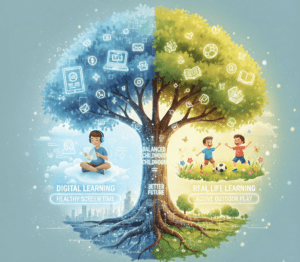
The challenge is not to remove screens completely, but to balance technology with real-life learning so that children grow in a healthy, holistic way. At Prime World Public School, Saket Meerut, this balance is treated as a priority. The school believes that screens should support learning, not replace real experiences, interactions, and emotional development.
Here are simple, practical, and meaningful ways to create the right balance for children.
🌱 1. Understand that Healthy Screen Time for Kids are Not All Bad
Before restricting screen time, it is important to understand its purpose. Not all screen use is harmful. When used correctly, digital tools can help children:
learn creatively
- understand difficult concepts
- practice skills through educational games
- explore new ideas through videos and stories
At Prime World Public School Saket Meerut , teachers use technology thoughtfully — interactive videos, educational apps, digital quizzes, and smartboard lessons are used only to support understanding, not to entertain children aimlessly.
As the school believes: “Screens can help, but life beyond screens helps even more.”
The key is guided, purposeful use rather than unlimited screen exposure.
👣 2. Encourage Real-Life Experiences Every Day
Children learn best when they touch, move, explore, and experiment. Real-life learning helps them understand the world deeply. Encourage activities like:
- reading physical books
- drawing or colouring
- helping in household tasks
- playing outside
- solving puzzles
- engaging in creative hobbies
At Prime World Public School Saket Meerut ,the curriculum includes hands-on activities, art projects, outdoor sports, and group tasks that allow students to learn by doing. Real experiences build creativity, curiosity, and problem-solving skills that screens alone cannot provide.
🧘 3. Schedule a Screen Time for Kids
Instead of saying “don’t use screens,” create a routine that children can follow. A healthy balance may look like:
- limited recreational screen time
- clearly defined digital learning time
- no screens during meals
- no screens 1 hour before bedtime
- mindful breaks between online tasks
 Prime World Public School encourages parents to follow structured routines at home similar to school schedules. When children know when they can use screens, they are less likely to misuse or overuse them.
🙂 4. Make Screen Time Interactive, Not Passive
Passive screen time—like scrolling or watching videos for long hours—can slow down thinking and reduce concentration.
But interactive screen time — where children think, create, or participate — can be beneficial.
Examples of interactive digital activities:
- online quizzes
- coding apps
- digital art tools
- e-storybooks with activities
- virtual science simulations
Teachers at Prime World Public School Saket Meerut , often combine interactive tools with class lessons so students stay involved, alert, and engaged. The aim is to turn screen time into a thoughtful learning experience.
🤝 5. Build Family Time Without Screens
Children learn from what they see. If adults are always on their phones, children will naturally want to do the same.
Create device-free moments at home, such as:
- evening walks
- board games
- shared storytelling
- cooking together
- simple conversations about the day
At Prime World Public School Saket Meerut ,students are often encouraged to share “screen-free moments” with their classmates. They get excited to talk about the activities they did without gadgets, which inspires others too.
🌿 6. Outdoor Play Is a Must
Outdoor activities are not just fun — they improve attention span, strengthen physical health, and reduce stress.
Encourage activities like:
- running
- skipping
- cycling
- playing with friends
- nature walks
Prime World Public School Saket ,Meerut ensures that sports and outdoor play are an essential part of the timetable. The school believes that when children play outside, they feel happier and learn better.
📚 7. Combine Traditional and Digital Learning
The best learning occurs when digital tools and traditional methods work together. A balanced approach might include:
- reading both e-books and paper books
- using digital tools to revise lessons
- writing classwork by hand
- doing science experiments physically and digitally
Teachers at Prime World Public School Saket Meerut , follow a blended learning model where technology enhances understanding but does not replace books, writing, or interactive classroom discussions.
🌟 8. Teach Digital Responsibility
Children should learn not just how to use screens, but how to use them wisely.
Teach them:
- the difference between educational and harmful content
- why too much screen time affects health
- rules of safe internet use
- how to take breaks and rest their eyes
Prime World Public School Saket ,Meerut regularly guides students on cyber safety and responsible technology use. Responsible habits at a young age lead to balanced tech behaviour in the future.
🌼 Conclusion: Balance Creates Healthy Minds
Balancing screen time and real-life learning is not about strict rules — it’s about harmony. With the right mix of digital tools, outdoor play, creativity, routines, and family time, children can grow into confident, thoughtful, and emotionally strong learners.
Prime World Public School, Saket Meerut, believes that children thrive when technology supports learning and real-life experiences enrich it.
After all, screens may show the world —
but real life helps children feel it, understand it, and grow within it.