At Prime World Public School Saket ,Meerut , we believe education is not just about textbooks, exams, or grades—it is about nurturing the whole child. Knowledge matters, but values shape character. While books teach facts, values teach children how to live, interact, and grow as responsible human beings.
In today’s fast-paced and competitive world, it is easy to focus only on academic achievement. But true education blends academics with values such as kindness, honesty, respect, and empathy. These qualities go beyond classrooms and prepare children to become leaders, problem-solvers, and compassionate citizens.
In this blog, we share the values we teach children beyond books—with practical examples from our classrooms and school life.
Values We Teach Children in School
1. Respect for All
Respect is the foundation of every relationship. We encourage students to respect teachers, parents, peers, school staff, and even nature.
Example in School:
-
- Children are taught to greet teachers and elders politely.
-
- During “Helper’s Day,” students thank school staff—drivers, cleaners, security guards—for their service.
-
- In classroom activities, children listen patiently when others speak, practicing respect for opinions.
- These values we teach children prepare them to become confident, kind, and responsible citizens.
Lesson for Life:
When children learn respect early, they grow into adults who value diversity, build healthy relationships, and create inclusive spaces.
2. Kindness and Empathy
Kindness may seem small, but its impact is huge. We teach children not only to “be kind” but also to understand others’ feelings—empathy.
Example in School:
-
- A “Kindness Jar” in every classroom allows children to share kind acts they did or received during the week.
-
- Students are encouraged to comfort classmates who feel left out.
-
- Storytelling sessions (like The Good Samaritan or folk tales) highlight empathy in action.
Lesson for Life:
Empathetic children are less likely to bully and more likely to become leaders who care for others’ well-being.
3. Teamwork and Cooperation
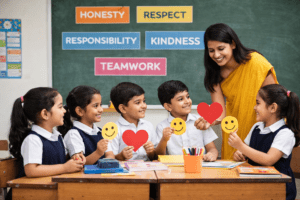
The world thrives on collaboration, not competition alone. That’s why teamwork is woven into our school culture.
Example in School:
-
- Group projects, such as making a model of the solar system, require students to divide tasks and work together.
-
- Sports days focus not only on winning but also on cheering for teammates.
-
- Classroom “buddy systems” pair older students with younger ones for reading or activities.
Lesson for Life:
Children who learn teamwork in school become adults who can lead and collaborate effectively in workplaces and communities.
4. Responsibility and Discipline
Children must learn to take responsibility for their actions and belongings. Discipline helps them stay organized and committed.
Example in School:
-
- Each child takes turns as a “class monitor,” responsible for keeping the board clean or distributing notebooks.
-
- Eco-club students ensure lights and fans are switched off before leaving classrooms.
-
- Homework planners teach children accountability for their studies.
Lesson for Life:
Responsible children grow into dependable adults who contribute positively to society.
5. Environmental Awareness
We believe children should grow up caring for nature and practicing sustainability.
Example in School:
-
- Tree plantation drives encourage children to nurture saplings.
-
- “No Plastic Day” teaches alternatives like cloth bags and steel bottles.
-
- Nature walks and gardening activities show children the joy of connecting with the environment.
Lesson for Life:
When children develop eco-friendly habits early, they grow into conscious citizens who care for the planet.
6. Gratitude
Gratitude teaches children to value what they have instead of constantly wanting more.
Example in School:
-
- Morning assemblies often include gratitude prayers.
-
- Students write “Thank You Cards” for teachers, parents, or friends during special events.
-
- A “Gratitude Wall” displays notes from children about small things they are thankful for—like a parent’s hug or a friend sharing a toy.
Lesson for Life:
Grateful children are happier, less stressed, and more optimistic.
7. Honesty and Integrity
Honesty builds trust, and integrity helps children stand strong even in difficult situations.
Example in School:
-
- Children are praised when they admit mistakes rather than punished harshly.
-
- “Truth Corner” sessions in class let students share incidents when they told the truth, even if it was hard.
-
- Stories like Pinocchio help children understand why honesty matters.
Lesson for Life:
Honest children grow into adults who value trust, fairness, and moral courage.
8. Celebrating Diversity and Inclusion
Our classrooms are diverse, and we teach children to appreciate differences—be it culture, religion, language, or ability.
Example in School:
-
- Festivals like Diwali, Eid, Christmas, and Holi are celebrated together.
-
- Children learn songs in different languages.
-
- Awareness programs teach respect for children with special needs.
Lesson for Life:
Children raised with inclusive values grow into adults who embrace diversity and work for a more united world.
How We Teach These Values
We don’t “lecture” about values. Instead, we integrate them into daily life:
-
- Stories & Role Play – Moral stories and drama help children experience values.
-
- Activities & Games – Kindness jars, gratitude walls, and eco-projects turn values into fun habits.
-
- Celebrations & Events – Festivals, community service days, and assemblies reinforce respect and togetherness.
-
- Teacher Role Models – Teachers lead by example, showing kindness, fairness, and patience in everyday actions.
-
- Parent Involvement – We encourage parents to continue these practices at home—like sharing gratitude at dinner or encouraging teamwork in chores.
Real-Life Example: “The Lost Pencil Story”
One day, a child in Grade 2 lost a pencil. Instead of blaming anyone, the teacher encouraged the class to think about honesty and responsibility. A few minutes later, another student quietly returned the pencil, admitting they had taken it by mistake.
The teacher didn’t scold; she praised the courage to admit the mistake. This small moment taught the entire class a powerful lesson: honesty is more important than fear.
Values based education is supported by global organizations like UNICEF. At Prime World Public School, values we teach children to guide their daily behavior, learning, and relationships.
Final Thoughts
Books and exams may help children score marks, but values help them score in life. At Prime World Public School Saket Meerut , we go beyond academics to shape compassionate, responsible, and confident young learners.
The world needs not only intelligent professionals but also kind humans, honest leaders, and responsible citizens. That is why we make sure every child learns lessons of respect, kindness, gratitude, and integrity along with math and science.
As we often say at school:
“We don’t just prepare children for exams. We prepare them for life.”